
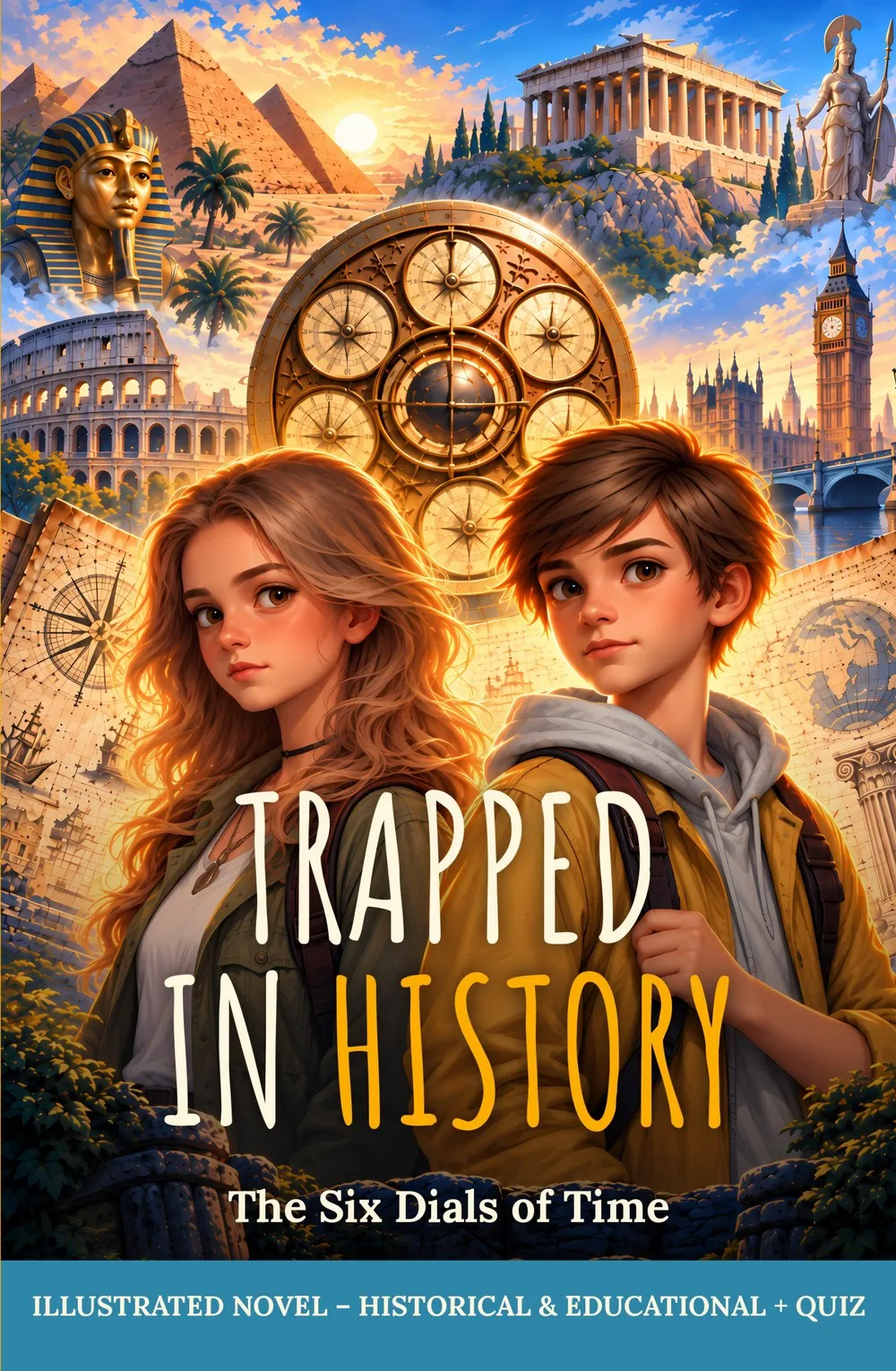
What does a 10-year-old remember about a period of history? Rarely a date. More often a detail that surprises them: a pharaoh barely older than they are, a race with no medal, a monk who designed an astronomical clock. Those are the details Trapped in History is built on.
Here are the six stops on Luca and Giulia’s journey, with what’s true, what’s made up, and a little something to do for each one. Everything below starts from “What’s true in this book,” the notes at the end of the novel, with a few extra facts.
- about 1330 BCTutankhamun
- from 776 BCThe Olympic Games
- AD 161-180Marcus Aurelius
- Middle AgesCastle and monastery
- born 1452Leonardo da Vinci
- 1800sLondon and Greenwich
Tutankhamun’s Egypt
Tutankhamun became pharaoh at about nine years old and died at about nineteen. His tomb was discovered in 1922 by the archaeologist Howard Carter, almost untouched, with its famous gold mask.
In the novel, a “star disc” waits for the children inside a pyramid. Both are made up: the star disc never existed, and Tutankhamun was really buried in the Valley of the Kings, in a tomb dug into the rock. The great pyramids of Giza were built about four and a half thousand years ago, so they were already more than a thousand years old in his time.
One more surprise: the pyramids were not built by slaves under the whip, as people believed for a long time. Archaeologists have found the village where the builders lived, with their bakeries and their tombs. Most of them were paid workers, who also received rations of bread and beer.
Try it at home
A question that gets kids talking: “Could you have ruled a whole country at nine?”
The first Olympic Games
The first recorded Olympic Games took place in 776 BC at Olympia, in Greece, in honor of the god Zeus. They were held every four years, and later there were even races for boys.
The winners didn’t get a medal. They went home with a crown of olive leaves. Athletes rubbed their bodies with olive oil, and the oldest event was the one Luca runs in the book: the stadion, a sprint of about 192 meters, the length of the stadium.
Try it outside
If you have a park or a schoolyard nearby, measure out those 192 meters with your child (a little more than two football fields) and time the race. The ancient Games make a lot more sense once you’ve run the distance yourself.
Rome under Marcus Aurelius
Marcus Aurelius reigned from AD 161 to 180. He was called the philosopher emperor, and the thoughts he wrote down for himself are still read today under the title Meditations. An emperor who kept a kind of diary: that changes the way kids picture the Romans.
The Colosseum that Giulia sees in the distance had already been standing for more than eighty years. In the story, a senator collects sextants, but that’s impossible: the sextant was invented in the eighteenth century, more than fifteen hundred years later, to help sailors find their position at sea. To tell the time, the Romans used sundials and water clocks.
Try it outside
On a sunny day, stand a stick in the ground and mark the tip of its shadow every hour. You’ve just made a simple sundial, the Romans’ way of keeping time.
The Middle Ages, between castle and monastery
In the novel, Giulia is a little hard on the Middle Ages. Many historians avoid the term “Dark Ages,” because it was also the time of cathedrals, the first universities and remarkable machines.
Monks really did brew beer. A plan for an ideal monastery, drawn around 820 and still kept at the Abbey of St. Gall in Switzerland, already includes three breweries: one for the monks, one for guests and one for pilgrims. The siege of a castle over a store of beer, on the other hand, is made up.
And a monk really did design an astronomical clock. Around 1330, Richard of Wallingford, abbot of St. Albans in England, designed one that showed the hours, but also the movement of the Sun, the Moon and the stars. A working reconstruction can be seen at St. Albans Cathedral.
Do it together
Type “Richard of Wallingford” into a search engine with your child, find a picture of the clock, and try to guess what its different circles show. That can easily fill a good fifteen minutes.
Leonardo da Vinci in Florence
Leonardo da Vinci was born in 1452 and trained in Florence, in the workshop of the painter and sculptor Verrocchio. The dome of Santa Maria del Fiore, whose bells Luca and Giulia hear in the book, had been finished about fifteen years before he was born.
In the novel, Luca asks the young Leonardo about the Mona Lisa, and Giulia kicks him, and she’s right to: Leonardo only began that painting around 1503, when he was about fifty. Its model is thought to be Lisa Gherardini, the wife of a Florentine merchant. Leonardo really did study lenses and the way light travels, and he filled his notebooks with ideas about them. But the first telescopes only appeared in 1608, in the Netherlands.
Try it at home
Fill a clear glass with water and look at a word through it: the letters look bigger. The curved water bends the light like a lens, the very thing Leonardo was so curious about.
London, the Royal Society and Greenwich
Last stop, the 1800s. The London fog is real: the smoke from thousands of coal fires mixed with the mist and made fogs so thick and yellow that Londoners called them “pea-soupers.”
The Royal Society, founded in 1660, is one of the oldest scientific academies in the world. In the book it is closed to people of humble birth, but in reality one of its most famous members, Michael Faraday, was a blacksmith’s son who started out as a bookbinder’s apprentice. Margaret is right about one thing, though: the Royal Society only elected its first women Fellows in 1945. The Royal Observatory at Greenwich was founded in 1675, and the Prime Meridian runs right through it: you can stand with one foot on each side.
And time travel?
Made up, for now. But Montague isn’t as mad as his colleagues think: in 1895, a Londoner called H. G. Wells published The Time Machine, one of the first great novels about time travel.
To take it further, draw a long timeline on a big sheet of paper and place the six stops on it, from oldest to most recent: more than thirty centuries fit on a kitchen table. If you’re a teacher, our free teaching guide offers this timeline, a “true, false… or we don’t know?” game and questions chapter by chapter. And the novel itself, Trapped in History, ends with a 12-question quiz, “Did you travel well?”, to check what young readers remember.